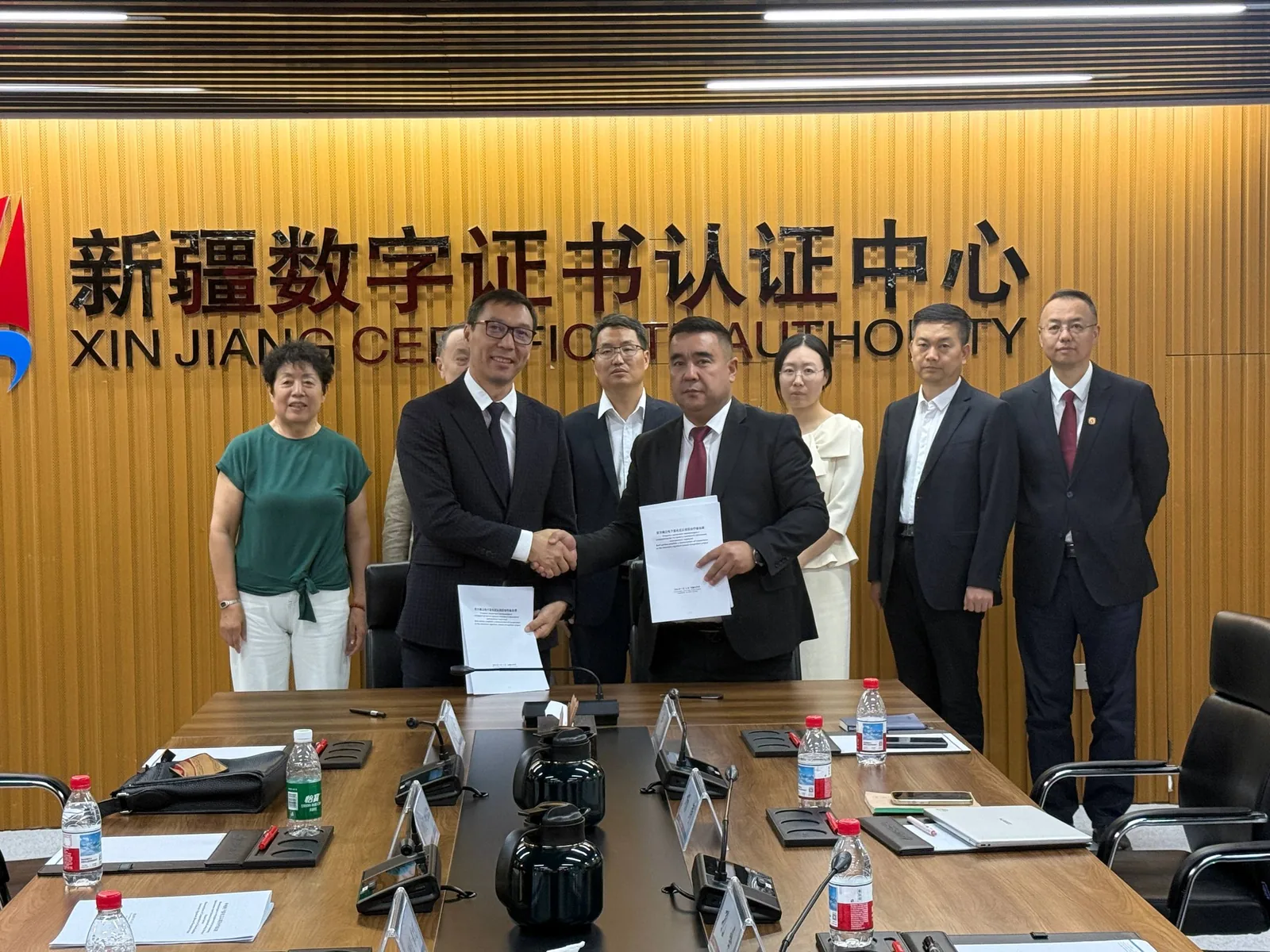
On 16 September 2026 in Urumqi, Documentolog Global Limited and the Xinjiang Digital Certificate Authentication Center (Xinjiang CA) signed a memorandum of cooperation on a project for mutual recognition of electronic signatures between Kazakhstan and China.
A container travels from Urumqi to Almaty in a few days. The contract for that container travels by courier for weeks. A Kazakh company’s electronic signature has to be verifiable on the Chinese side, and a Chinese partner’s signature has to be verifiable in Kazakhstan. Until such a channel exists, documents for bilateral trade are still signed on paper.
What the memorandum provides for
The parties are setting up a standing cooperation mechanism and a technical working group. The priority scenarios are bilateral contracts, customs documents and commercial certificates. The memorandum records the parties’ intentions: specific projects, technical agreements and commercial terms will be set out in separate contracts.
Who needs it
An exporter agrees a contract with a buyer in Xinjiang and waits for the signed copy before shipping. A customs broker assembles the document package while the cargo waits at the border. An importer needs a commercial certificate from a Chinese supplier before paying for a delivery. A logistics company signs an addendum with its partner for every run. In all four cases, the timeline of the deal is set by the courier, not by the goods.
“At the table in Urumqi, the conversation was not about supplying software but about how trust will work in a trade corridor. On the Kazakh side of that table sat a Kazakh company,” — Baizhan Kanafin, CEO of Documentolog.
About Documentolog and d8n.ai
Since 2007, Documentolog has been building electronic document management in Kazakhstan; 150,000 organisations use the company’s platform. In December 2025 the company launched d8n.ai, a multi-agent AI Business Operating System in which AI agents carry out routine operations inside business processes under human control.
The company will report separately on the first results of the technical working group.