Six months ago, an incoming document at Documentolog was registered by a person. They opened the letter, identified its type, picked the right owner, put it under control. That was a job — justified, paid for, with a clear output norm.
Today the Records agent does all of it. A person steps in where the agent is unsure.
Sentences like that are easy to say on a conference stage. Living through them inside your own company, where every line of that kind has a name and a face, is much harder. We lived through it. Here is what came out of the past six months.
What the agents rewrote inside us
Documentolog now runs the Records, Assistant, Finance, Legal, Meetings, Marketing, Sales and Support agents.
Every document — inbound and outbound — is handled first by Records: it classifies the document, assigns the owner, puts it under control. In parallel, Legal reviews each one. Meetings keeps the minutes and tracks the action items. Assistant takes routine work off each employee personally.
We went furthest in technical support. The first line is now almost entirely covered by an agent, and our people moved on to the complex cases where a human is genuinely needed.
What our clients got out of it
The headline of the half-year: we moved every one of our clients onto d8n.ai. All of them got a new interface and new capabilities — corporate chat, mail, calendar and drive in the same perimeter as their documents.
When you carry a large installed base, a migration like that never goes smoothly. Ours did not go smoothly either. But we got it done — and now every client has the thing that matters most: readiness to switch AI agents on. We start in August.
The first agent we handed to clients is technical support — the same one already working for us. We trained it on our systems and our knowledge base, and it runs the first consultation itself, answering right there in the chat. When a question is beyond it, it does not send the person around in circles: it opens a ticket with our support team and follows it through to an answer.
This is only the first version. Support should become proactive — not waiting for the question but flagging the problem — and it should live in the client’s phone, not in an office.
We are not handing clients a slide deck. We are handing them what we tested on ourselves first, with all the mistakes that came with it.
What an agent changes in a person
Here is the main conclusion of the half-year, and it is not about technology.
An agent does not change the speed of a person’s work — it changes its very format. What was a justified, paid job yesterday becomes an exception handled manually a few times a month. The value of a person to the company shifts: from the number of manual operations completed to decisions that carry meaning and impact.
The pace of that change is such that not everyone keeps up. That is an honest conclusion drawn from our own experience rather than from the sidelines: a transformation this deep always means stepping out of the comfort zone.
Where we put the time we freed up
Let me be clear on one thing: this rebuild is not a management whim, nor a company’s wish to “transform”. The world around us changes faster than companies manage to react, and a technology vendor that builds products for other people’s automation has no right to ignore that. If we ourselves work the old way, our product is worth nothing.
Then the arithmetic starts. The agents took the routine away and freed up an enormous amount of our people’s productive time — and they will free up more. At that point a company faces exactly two forks in the road on how to count that time.
The first: keep the same number of clients and cut headcount. Then efficiency is measured by how many employees are no longer needed. The second: keep the team and grow the number of clients. Then that same efficiency is measured by output per person.
That is precisely how you calculate the ROI of deploying AI agents. And here is the principle: I do not believe in changes that cannot be measured. If after a rollout you cannot name a specific number that moved, it was not a transformation — it was a technology purchase. An investment without a metric is not an investment, it is an expense.
We chose the second fork. The time we freed up goes into growth, not into cuts.
That is why this half-year we moved beyond Kazakhstan: the international version of d8n.ai went live and we opened a company in Uzbekistan. By the end of the third quarter we will open companies in Kyrgyzstan, Azerbaijan and Türkiye. And we will do it primarily with the same agents — otherwise entering five markets would require a headcount we do not have and do not plan to hire.
How we share what the agents earned
On 18 July we took the whole team out of the city, to the Chistye Prudy resort in Kosshy. It is a tradition for us: twice a year we go out to the countryside and give a full day to each other — we rest, we sum up the results briefly, we recognise the best. Stepping out of the comfort zone is exactly what we discussed there, openly.

And there we also handed out phantom share certificates. Everyone who has worked at the company for a year receives a share of its net profit — secured by contract, paid out twice a year. Not a bonus, not a keepsake. There is one threshold: a year of work. Not a title, not a grade, not proximity to management. More than thirty people received certificates this half-year.
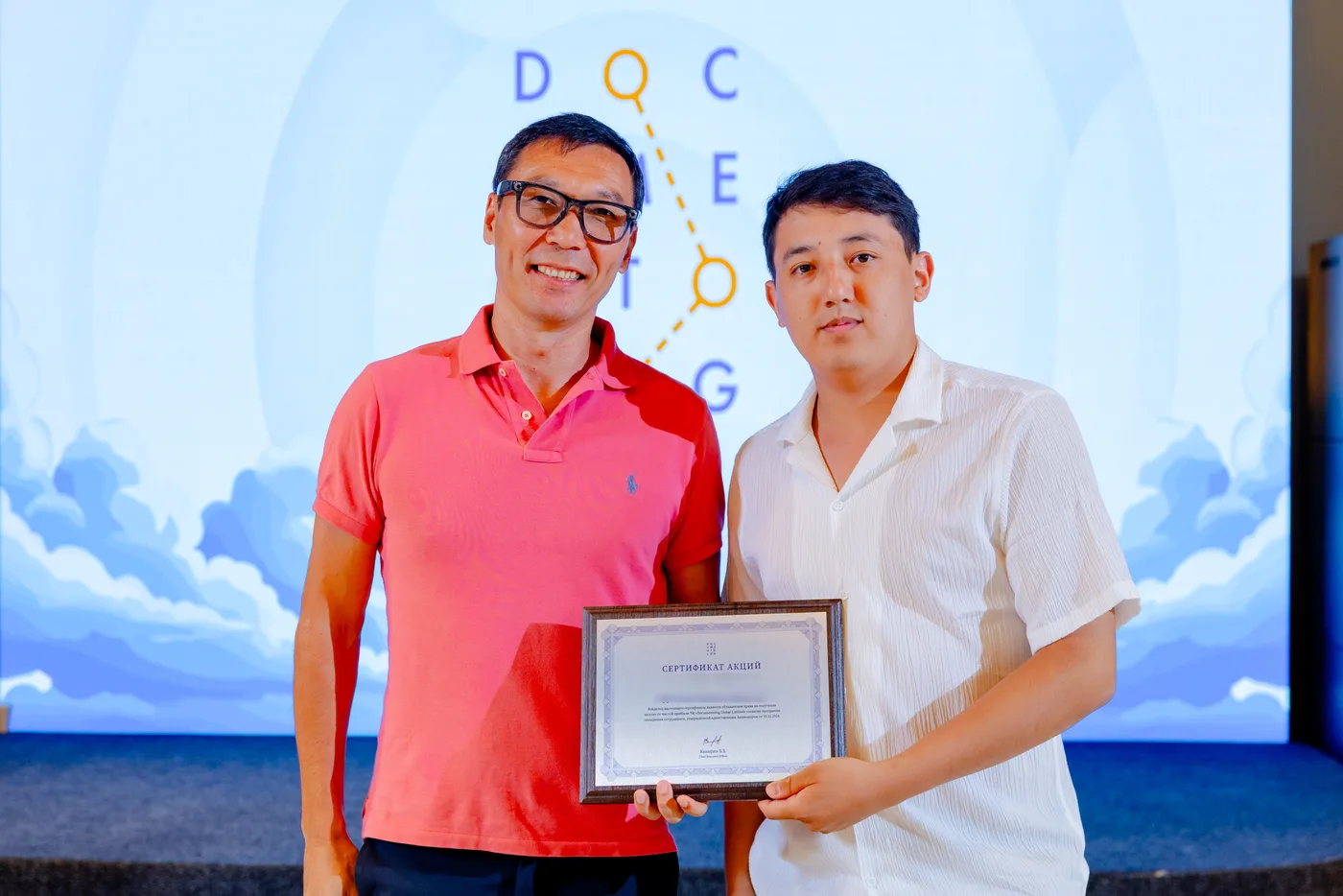
Let me be precise here. A person in this situation has no choice: it is the work itself that changes, not their wish to change it. That makes it all the more important that the upside from those changes does not stay with the company alone.
The link is direct and countable. Agents take away the routine — productivity goes up. Productivity goes up — profit goes up. Profit goes up — the payout on the shares goes up for every holder. Not an abstract “we are all in the same boat”, but real money twice a year, tied to exactly the outcome we are changing everything for.
Progress cannot be stopped, and a company that does not rebuild now will be competing against those that already have. But rebuilding a company at the expense of its people is a poor strategy. Rebuilding it together with them, by making them co-owners of the result, is the only one that works over the long run.
These were six months that changed how we think and laid the foundation. It is a foundation you can grow on quickly. The second half of the year will show how well we laid it — I will come back with the numbers.