ROI worksheet: model the economics of one process
MIT examined 300 enterprise AI deployments: 95% of pilots produced no measurable impact on profit. The difference between them and the 6% that did create material value was not the model — it was what they measured. This file models one specific process, before and after.
The calculation stays open
This is not a teaser or a result hidden behind registration. It is the calculation itself, using the example data. For a records process with 300 operations per month, the model uses 30 → 6 minutes, 6 → 2 manual touches, errors at 12% → 4%, overdue work at 18% → 6%, and a 50% time-reuse factor.
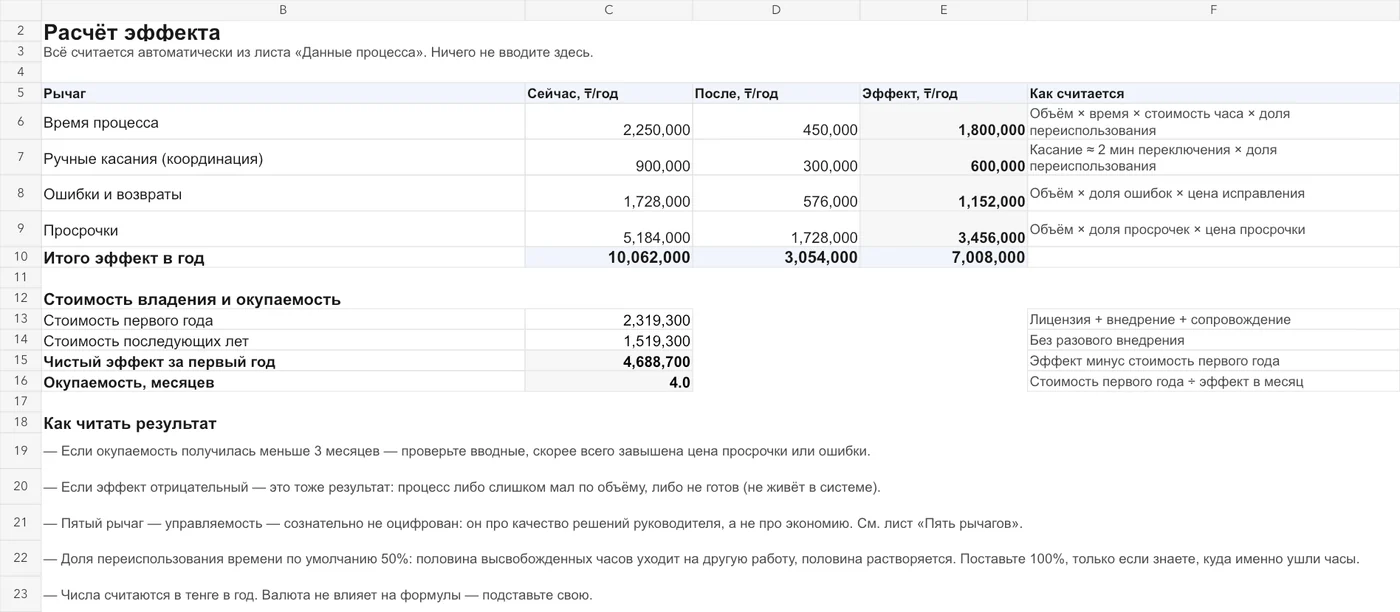
| Lever | Before, KZT/year | After, KZT/year | Impact, KZT/year |
|---|---|---|---|
| Process time | 2,250,000 | 450,000 | 1,800,000 |
| Manual touches | 900,000 | 300,000 | 600,000 |
| Errors and rework | 1,728,000 | 576,000 | 1,152,000 |
| Overdue work | 5,184,000 | 1,728,000 | 3,456,000 |
| Total annual impact | 10,062,000 | 3,054,000 | 7,008,000 |
| First-year ownership cost | — | — | 2,319,300 |
| Net first-year impact | — | — | 4,688,700 |
| Payback | — | — | 4.0 months |
The fifth lever — manageability — is deliberately excluded from the sum. There is no honest universal formula for turning decision quality into cash.
Download the file
Get the working ROI file
Enter your email. We will send a one-time link valid for seven days; no attachments.
What the file looks like
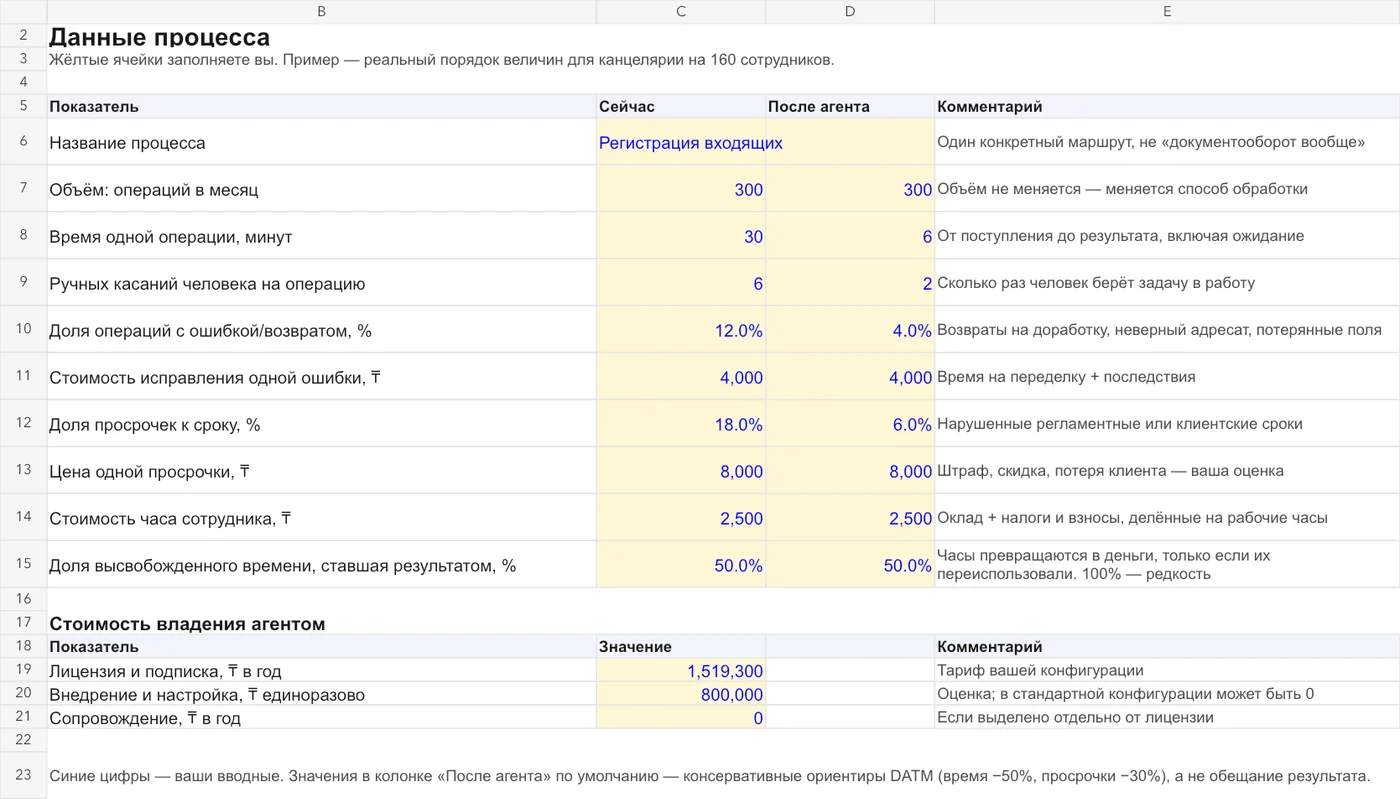
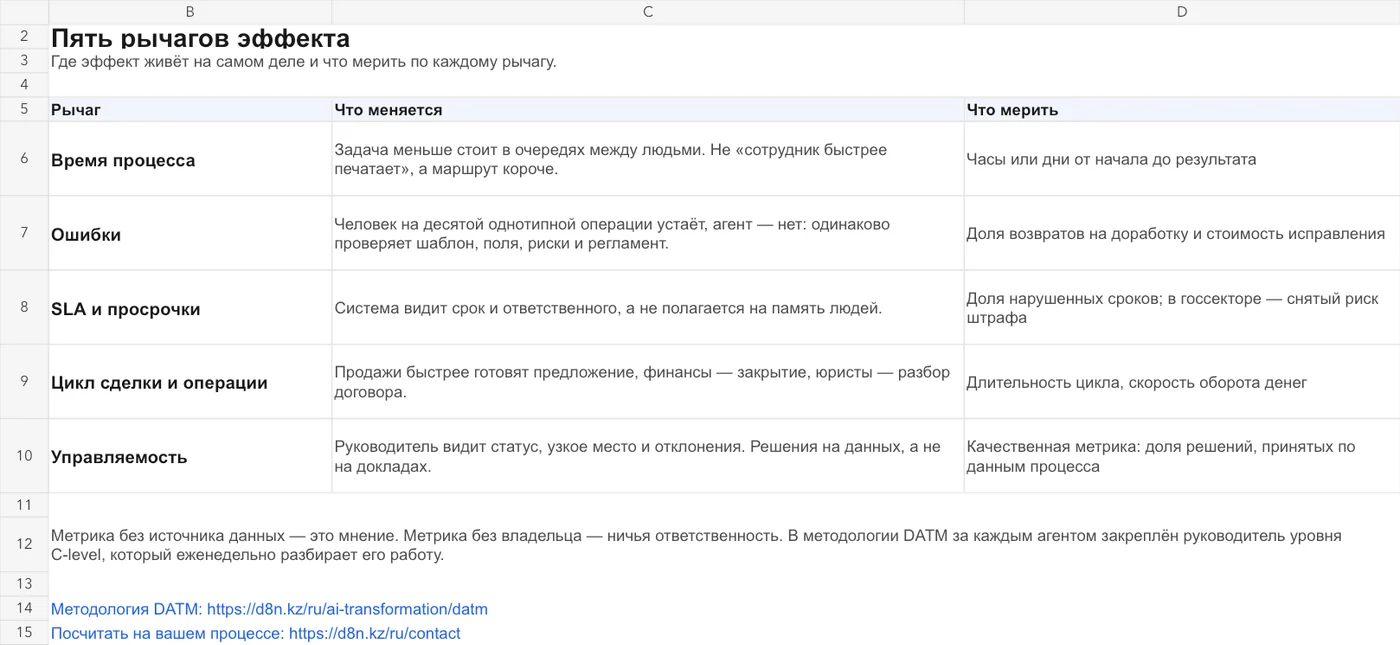
The five impact levers
- Process time. Employee hours released from the operation. They turn into money through the hourly cost — and only with the time-reuse factor applied: released hours only become money when the business puts them to productive use.
- Manual touches. Handoffs between people. Every touch is a queue, a context switch and a point of loss.
- Errors and rework. The cost of redoing work: every error sends the task back and consumes time on both sides.
- Overdue work. The cost of a missed deadline — penalties, escalations and lost enquiries.
- Manageability. The fifth lever improves decision quality rather than producing a simple saving, which is why it is explained separately and excluded from the sum.